Since 1987, Operation Smile has provided high-quality surgical care for over 10,200 patients in Kenya. We rely on the skill, passion and dedication of nearly 90 skilled medical volunteers from Kenya to deliver safe surgery and comprehensive cleft services.
But there is more to do.
During Fiscal Year July 2025 -June 2026, Operation Smile will invest $859,600 to deliver surgery to approximately 300 patients and provide educational opportunities for nearly 430 health workers.
Over the course of the next three years, Operation Smile will provide approximately 1,280 patients with surgery and train general and plastic surgeons through our partnership with the College of Surgeons of East, Central and Southern Africa (COSECSA).
Cleft Care Programs
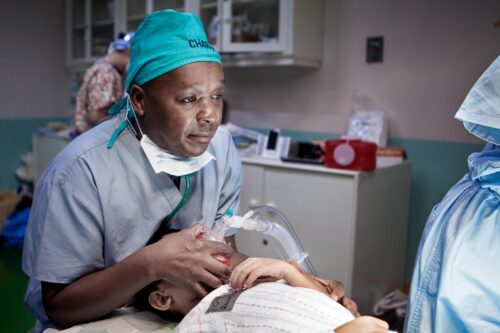
Operation Smile projects to deliver safe surgeries to nearly 300 patients in Kenya. We will also provide oral health care to approximately 170 patients, speech care to nearly 110 patients, nutrition care to 220 patients and psychosocial care to 80 patients.
Education Programs
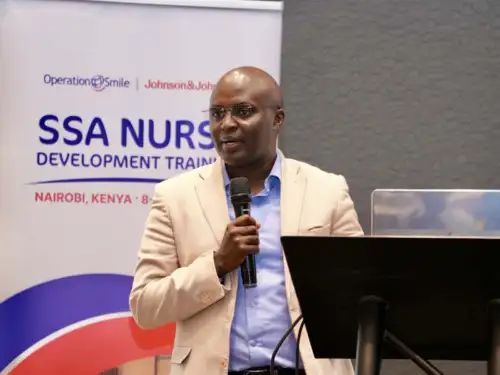
Operation Smile will provide training and education for nearly 430 health workers in surgery, pediatrics, nursing, speech therapy, oral health, nutrition, burn care, biomedical engineering and anesthesia. We will engage medical students from the University of Nairobi to support programmatic activities such as direct patient care and community awareness campaigns. In collaboration with the American Heart Association, Operation Smile will deliver Basic Life Support training.
Operation 100, our bold strategy to bring essential surgical care closer to patients’ homes, will impact Kenya this year as we equip cleft operative teams at Kenyatta University Teaching Referral & Research Hospital in Kiambu and Shoe for Africa Children’s Hospital in Eldoret with advanced skills, essential equipment and enhanced health care infrastructure.
THE NEED
One in 500-750 births. It is estimated that, worldwide, a child is born every three minutes with a cleft condition — about one in every 500 to 750 births.
Shortage of health workers. Kenya has just two specialist surgical workers per 100,000 people, which falls short of the target set by The Lancet Commission on Global Surgery of 20 providers per 100,000 population. The shortfall of Kenya’s medical professionals is exacerbated by a mass brain drain. Between 30 to 40% of the estimated 600 doctors who graduate in Kenya annually move to other countries.
Limited hospital capacity. The Lancet Commission proposed that at least 80% of the population should live within two hours of a hospital that is equipped to perform the three bellwether procedures: laparotomy, cesarean delivery and open fracture care. Although 90% of Kenyans live within two hours of a hospital, just 52% of the country’s surgically equipped hospitals are capable of laparotomy. This suggests that the proportion of hospitals capable of performing all three bellwether procedures is 52% at most.
Financial burden. The Lancet Commission proposed that, to meet populations’ needs, countries should achieve 5,000 surgical procedures per 100,000 population. In Kenya, medical providers perform just 263 procedures per 100,000 people. The insufficient number of surgical procedures exacerbates the impact of high out-of-pocket expenses, making it even more challenging for patients with cleft conditions to access care. 36% of the population is at risk of impoverishing expenditure for surgical care, while 21% risks catastrophic expenditure for surgical care.
BRINGING CARE CLOSER TO HOME
To ensure that every child has access to care closer to home, we equip the providers within our patients’ communities with skills and resources to deliver high-quality care. We strengthen health system capacity by harnessing the talent and resources concentrated in larger cities, the hubs, to train providers in under-resourced areas, the spokes, where access to care is most limited.
In Kenya, Kenyatta University Teaching Referral & Research Hospital in Kiambu, AIC Kijabe Hospital in Kijabe and Shoe4Africa Children’s Hospital in Eldoret serve as hubs, providing year-round care for patients and training opportunities for health workers. Through Operation 100, we will also provide support in equipping operative teams.
THREE-YEAR VISION
Over the course of the next three years, Operation Smile will provide approximately 1,280 patients with surgery. We will also deliver consultations to over 3,590 patients.
Operation Smile will coordinate surgical programs across Kenya, directing resources to counties with the highest need. We will also continue to invest in the health workforce, increasing the quantity of care and enhancing the skills of local medical providers. Specialized training, combined with hands-on experience and credentialing at short-term surgical programs, will strengthen independent surgical teams at the spokes. This will build local capacity to deliver safe surgeries and reduce the need for patients to travel to Nairobi.
Operation Smile will support the speech program at Kenyatta University and train surgeons through our partnership with The College of Surgeons of East, Central and Southern Africa (COSECSA). Operation Smile will provide education opportunities for pediatric anesthesiologists in collaboration with the University of Nairobi.
Operation Smile will establish teaching and training pathways, such as the Cleft Surgery Training Program, for COSECSA fellows from Kenya and across the region. Kijabe’s simulation labs will be used for anesthesia training, with a focus on pediatric anesthesia, and additional opportunities will be developed for the College of Anesthesiologists of East, Central and Southern Africa(CANECSA) fellows.
Operation 100, our bold strategy to bring essential surgical care closer to patients’ homes, will impact Kenya as we equip cleft operative teams at Kitale County Referral Hospital in Kitale and Port Reitz Sub-County Hospital (CGTRH) in Mombasa with advanced skills, essential equipment and enhanced health care infrastructure over the next five years.