

Operation Smile has been working in Bolivia since 1999, providing high-quality care for children born with cleft conditions. Since then, Operation Smile has delivered over 4,750 surgeries and built a strong network of more than 170Bolivian volunteers across various specialties.
But there is more to do.
In Fiscal Year July 2025-June 2026, Operation Smile will invest $868,400 to perform life-changing surgeries for nearly 290 patients and provide education and training for over 310 health workers.
Cleft Care Programs
This year, Operation Smile will deliver surgery to nearly 290 patients. We will expand comprehensive care by providing consultations in oral health (∼890 patients), nutrition (∼70 patients), psychosocial care (∼40 patients) and speech therapy (∼370 patients).
Education Programs
Operation Smile will provide training and education for over 310 medical providers across various specialties, including surgery, anesthesia, plastic surgery, nursing, pediatrics, biomedical technology, oral health, psychology, speech therapy and post-anesthesia care. Basic Life Support training will be delivered in collaboration with the American Heart Association.
Operation 100, our bold strategy to bring essential surgical care closer to patients’ homes, is progressing through specialized training for cleft teams at Hospital Japonés in Santa Cruz, the hub, supported by investments in health infrastructure and essential equipment. Operation Smile will also equip cleft operative teams at Clinica Arébalo in Cochabamba and Clinica Unifranz in La Paz, the spokes, to expand access to high-quality care.
THE NEED
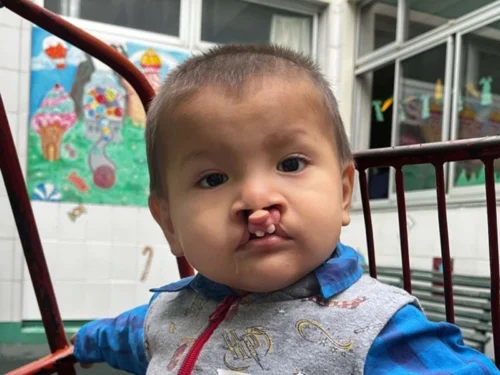
One in 350-500 births. Bolivia has the highest reported prevalence of cleft cases in the world. In some regions, one in 350-500 babies is born with a cleft condition. Operation Smile’s survey revealed that 95% of patients arriving at Operation Smile programs in Bolivia could not have undergone surgery without the support of Operation Smile.
Shortage of health workforce for cleft-affected patients. The burden of cleft disease is amplified by the fact that Bolivia has just 34 specialized surgical workers per 100,000 people. In high-income countries, the rate stands at 71 specialized surgical workers.
Financial burden. Considering that 57% of patients arriving at Operation Smile programs in Bolivia live below the poverty line and 63% have no health insurance, many are vulnerable to out-of-pocket payments. This situation leaves 11% of Bolivians at risk of impoverishing expenditure for surgical care. Additionally, 8% of the population faces catastrophic expenditure for surgical care.
Limited surgical capacity. The Lancet Commission on Global Surgery proposed that countries should perform 5,000 surgical procedures per 100,000 people. Bolivia achieves just 2,305 procedures per 100,000 people, leaving behind many people born with cleft lip and cleft palate. 33% of patients arriving at Operation Smile programs do not have a hospital within two hours of their home. The Lancet Commission suggests that at least 80% of the population should live within two hours of a hospital.
Barriers to education and employment. In Bolivia, 30% of patients arriving at Operation Smile programs said that their condition limited their school attendance, while 31% said that their school performance is impacted by their condition. 27% of caretakers we surveyed stay home to care for their children.
BRINGING CARE CLOSER TO HOME
To ensure that every child has access to care close to home, we equip the providers within our patients’ communities with skills and resources to deliver high-quality care. We strengthen health system capacity by harnessing the talent and resources concentrated in larger cities, the hubs, to train providers in under-resourced areas, the spokes, where access to care is most limited.
In Bolivia, Operation Smile provides care at Hospital Japones, our hub in SantaCruz.
An operative team at Clinica Arébalo in Cochabamba will be equipped as a part of Operation 100 and will serve as a spoke.
Clinica Unifranz in La Paz is also part of Operation 100 and will serve as an additional spoke.
FIVE-YEAR VISION
Operation Smile Bolivia, as part of our Operation 100 strategy, will expand access to comprehensive cleft care across La Paz, Cochabamba, and Santa Cruz, three cities representing 70% of the country’s population. Over the next five years, we plan to deliver ∼2,000 surgeries and ∼31,500 consultations for∼14,500 patients.
Hospital Japonés in Santa Cruz will serve as the central training hub, providing structured pathways to develop cleft teams and build capacity for comprehensive cleft care. This effort is supported by investments in health infrastructure, essential equipment, and specialized training to strengthen surgical capacity across the country.
University partnerships are essential for strengthening our comprehensive care programs and fostering collaboration across multidisciplinary services. These partnerships will support workforce development, while a targeted recruitment strategy will engage hospitals, community networks and outreach channels to reach more patients in need of care.